
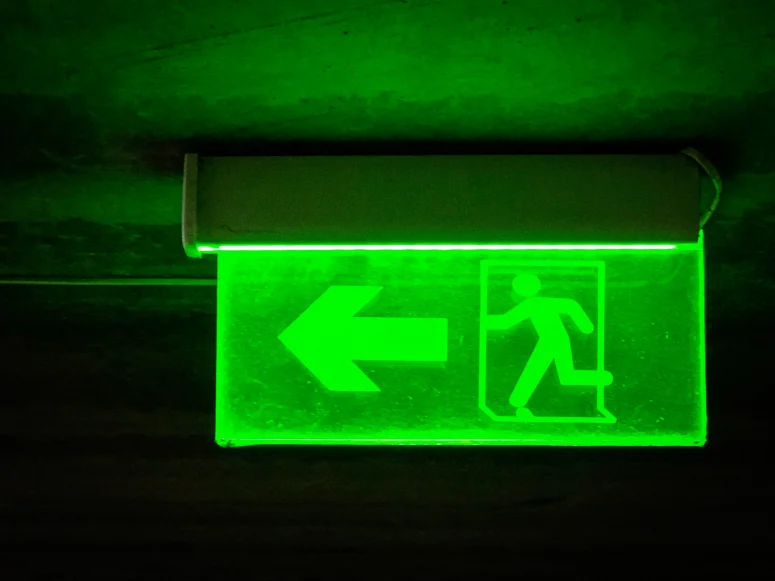
Emergency lighting is an essential element of safety for all public buildings, including shops, cinemas, restaurants, and apartment blocks. Safety and emergency lighting is designed to provide illumination should the standard lighting supply fail, and can be classified in different categories:
- Standby lighting: backup lighting should the mains power supply fail.
- Emergency escape lighting: designed to assist people with the safe exit from a building.
Typically, safety and emergency lighting powered by batteries is housed in a luminaire or are connected to an emergency power network independent of the mains supply.
What Is The Purpose of Emergency Lighting?
Emergency lighting can make the difference between life and death in a crisis.
Designed to operate should the mains power supply fail, emergency lighting provides occupants of a building with a clearly defined way out when an evacuation is necessary; typically, this will be if a fire breaks out and the main electricity supply fails. In this situation, with the additional problem of smoke filling corridors and rooms, a building that is then plunged into darkness poses a serious threat to safety. When confusion and panic are added to the equation, there is a risk that occupants could become trapped, unable to locate the emergency exits.
Where Should Emergency Lights Be Positioned?
When strategically positioned, emergency lighting will illuminate key escape routes, such as stairways and corridors, as well as fire-fighting equipment. Guided by the lighting, occupants should be able to find their way to the emergency exits and escape from the building before they come to any harm.
While legal requirements dictate that the position of emergency lights should be determined as part of an evacuation plan, broadly speaking they should be installed in the following areas:
- All exit doors
- Corridor intersections
- On all external escape routes
- Stairways and other changes in floor level
- Emergency escape signs
- Fire-fighting equipment
- Fire alarms
- Lifts
- Windowless rooms/toilets in excess of 8m²
Contact PTT To Find Out About Our Emergency Lighting Course
At PTT, our one-day emergency lighting course is designed to equip electricians and maintenance staff with the knowledge and understanding of the requirements for emergency lighting installations, to ensure they accord with the latest UK regulations.
To find out more, or to register a place on our course, please get in touch today.
Image Source: Unsplash


